Last updated: 2026 | Originally published: September 5, 2023
Chlorophyll starts breaking down in New York’s trees around the last week of September, and by the time it is done, the city looks like a different place. Color often peaks in the city’s parks by late October, holding through the second week of November before winter takes over. This is where to actually see it: 22 spots across all five boroughs, from a 150-acre ravine in Prospect Park to a 400-year-old tulip tree in Queens.
Table of Contents Show

Best Autumn Foliage in Brooklyn
Owl’s Head Park
📍 Location: Shore Road, 68th Street & Colonial Road — Bay Ridge, Brooklyn | 🌐 Website: Owl’s Head Park | Phone: [212] 639-9675
Set on a glacial moraine overlooking New York Harbor and the Verrazzano-Narrows Bridge, Owl’s Head is planted with beeches, oaks, pines, locusts, maples, corks, and tulip poplars. By early November, the central loop’s towering trees turn fully fall-colored, with the harbor as a backdrop most Brooklyn parks cannot match.

Prospect Park
📍 Location: 95 Prospect Park West — Prospect Park, Brooklyn | 🌐 Website: Prospect Park | Phone: [718] 965-8951
Home to 150 tree species, including rarities like the cutleaf beech, single-leaf ash, and weeping mulberry, Prospect Park’s real showpiece is the 150-acre Ravine, one of the borough’s few remaining substantial forested ravines. Through October and November, it turns gold and orange in a way that is easy to forget is inside city limits.

Fort Greene Park
📍 Location: DeKalb Avenue & South Portland Avenue — Fort Greene, Brooklyn | 🌐 Website: Fort Greene Park | Phone: [212] 639-9675
Whether you are walking the paths or climbing to the Prison Ship Martyrs Monument, early November brings out London planes, oaks, sugar maples, elms, honey locusts, and Osage orange trees in yellows, reds, and browns. The park’s own tree-trail map is worth following if you want to identify what you are looking at as you go.

Top Autumn Foliage in Manhattan
Highbridge Park
📍 Location: Riverside Drive/Edgecombe Avenue, West 155th Street to Dyckman Street — Washington Heights, Manhattan | 🌐 Website: Highbridge Park | Phone: [212] 639-9675
Named for the city’s oldest standing bridge, this 130-acre park holds northern red oaks, white ashes, hickory, black cherries, Norway maples, tulip trees, black birches, sassafras, and hackberry. The trail along the Harlem River, past the bridge itself and the old water tower, is the best way to take it in.

Inwood Hill Park
📍 Location: Payson Avenue & Seaman Avenue — Inwood, Manhattan | 🌐 Website: Inwood Hill Park | Contact: [212] 639-9675
The last natural salt marsh and old-growth forest left in Manhattan, Inwood Hill pairs its fall color with real geology—rock formations, glacial caves, and views of the Hudson and the Palisades from Overlook Meadow. The blue trail winds through oaks, hickory, and tulip poplars for anyone who wants a longer walk than a quick park loop.

Central Park Conservancy
📍 Location: Central Park Conservancy, 717 5th Avenue — Central Park, Manhattan | 🌐 Website: Central Park Conservancy | Contact: [212] 310–6600
Central Park’s 18,000 trees, American elms, oaks, Norway and sycamore maples, red maples, black cherries among them, turn from late October into early November, peaking around mid-October in a mix of gold, red, copper, and orange. The Conservatory Garden at the park’s north end, a designated Quiet Zone, is a calmer alternative to the busier stretches, with magnolias, chrysanthemums, orange crabapple allées, and Stewartias adding their own color.
The park’s Loeb Boathouse still runs rowboat rentals on the lake if you want the reflections without the crowd noise on land.

Fort Tryon Park Conservancy
📍 Location: Riverside Drive to Broadway — Washington Heights, Manhattan | 🌐 Website: Fort Tryon Park Conservancy | Contact: [212] 795-1388
Home to the Cloisters and the Heather Garden, the largest garden with unrestricted public access in the city, Fort Tryon spans 67 acres and roughly 500 species of shrubs, herbs, and perennials. Its heath collection, 48 species strong, turns copper and chocolate by late October, with the park’s drooping elms following into yellow and orange by late November.
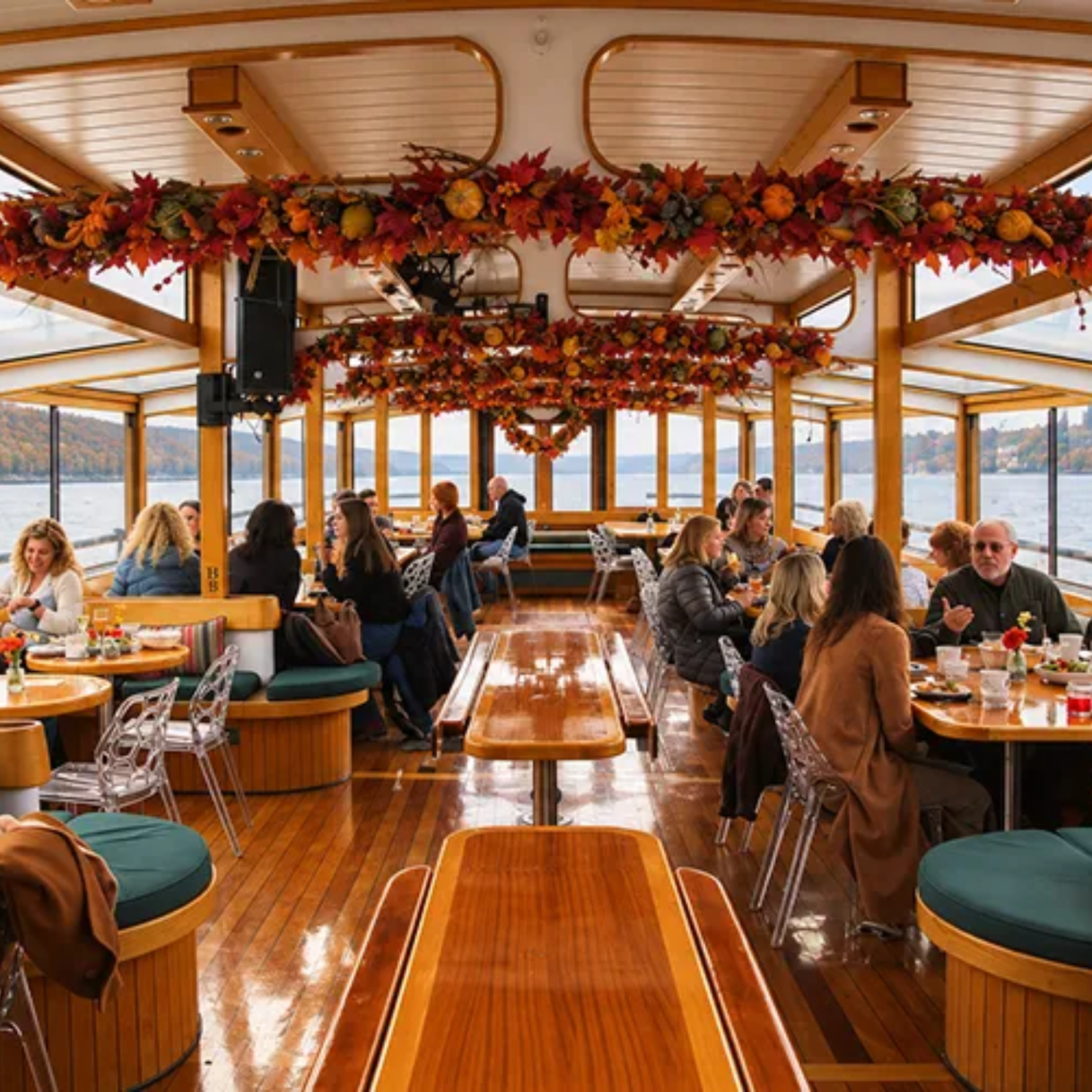
Fall Foliage Brunch Cruise with Classic Harbor Line
📍 Departs from: Chelsea Piers, Pier 62 — Chelsea, Manhattan | 🌐 Website: Classic Harbor Line | Season: October 3–November 15, 2026 | Duration: 2.5 hours | Tickets: From $102
Classic Harbor Line’s 1920s-style yacht sails north from Chelsea Piers past the George Washington Bridge toward the Palisades, with a three-course brunch and a complimentary Bloody Mary, mimosa, beer, or wine included. Saturday and Sunday mornings only. It sells out most weekends once the color peaks; book ahead rather than trying to walk up.

Must-See Autumn Foliage in Queens
Cunningham Park
📍 Location: Francis Lewis Boulevard & Union Turnpike — Fresh Meadows, Queens | 🌐 Website: Cunningham Park | Phone: [212] 639-9675
Oaks, hickories, and honey locusts line the southern trails here in bold red and yellow, but the deciduous tulip trees are the real draw, turning a deep, glowing gold that stands out even against the rest of the park’s color.

Kissena Park
📍 Location: Kissena Boulevard & Booth Memorial Avenue — Flushing, Queens | 🌐 Website: Kissena Park | Phone: [718] 359-1297
Kissena Park’s grove has been growing since 1839, with Japanese maple, Manchurian linden, weeping beech, oak, bald cypress, and willow among its older specimens. The katsura trees steal the show each fall in apricot and buttery yellow, while the bald cypresses turn cinnamon and tan.

Forest Park
📍 Location: Myrtle Avenue — Woodhaven, Queens | 🌐 Website: Forest Park | Phone: [718] 235-0815
The largest continuous oak forest in Queens holds northern red oak, scarlet oak, tulip poplar, shagbark hickory, white oak, and wild black cherry. Scarlet oaks turn a truly striking orange-red here, and the Pine Grove’s century-old evergreens along the Orange Trail add a yellowish tint of their own by late October.

Alley Pond Park
📍 Location: Union Turnpike — Oakland Gardens, Queens | 🌐 Website: Alley Pond Park | Phone: [212] 639-9675
At 635 acres, Alley Pond mixes hiking trails, meadows, ponds, and marshes, with white pines, black cherries, flowering dogwoods, black locusts, beeches, sweetgums, and red maples turning through mid-October. The half-mile Tulip Tree Trail leads to the Alley Pond Giant, also known as the Queens Giant, a 133.8-foot tulip poplar estimated at 350 to 450 years old and generally considered the oldest living thing in the city. The 15,000-year-old, glacially fed Oakland Lake nearby adds pin, black, and red oaks turning russet and scarlet.

Scenic Autumn Foliage in the Bronx
New York Botanical Garden
📍 Location: 2900 Southern Boulevard — Bronx | 🌐 Website: New York Botanical Garden | Contact: [718] 817-8700
NYBG’s 50-acre Thain Family Forest, the historic Hemlock Grove along the Bronx River, is the centerpiece here: oak, red maple, and tulip trees turning gold, orange, and red, star-shaped sweetgum leaves going red and purple, and scarlet oaks living up to their name. Peak timing shifts slightly year to year, so check the garden’s own foliage tracker before planning a visit.

Bronx River Greenway
📍 Location: 1490 Sheridan Boulevard — Bronx | 🌐 Website: Bronx River Greenway | Phone: [718] 542-4124
The Bronx River corridor runs through oaks, sassafras, red maples, tulip poplars, sycamores, beeches, and London plane trees, with beavers, fish, and a wide range of birds along the way. The Alliance runs guided canoe trips on the river each fall—check their calendar for early November dates, when the color along the banks is at its best.

Van Cortlandt Park
📍 Location: Broadway & Van Cortlandt Park South — Bronx | 🌐 Website: Van Cortlandt Park | Phone: [718] 430-1890
The city’s third-largest park spans 1,146 acres of red oaks, sweetgums, sugar maples, and hickory, turning yellow and red by November before fading within a few weeks. The two-mile John Muir Trail cuts through Croton Woods and both the Northeast and Northwest Forests, following the Putnam Trail along Van Cortlandt Lake’s southern edge.

Pelham Bay Park
📍 Location: Middletown Road & Stadium Avenue — Pelham Bay, Bronx | 🌐 Website: Pelham Bay Park | Phone: [718] 430-1891
New York City’s largest park, at 2,770 acres, holds the Kazimiroff Trail through Hunter Island’s oak forest, oaks, sweet gums, Norway spruces, white pines, and hickory turning together each fall. The Split Rock Golf Course is home to 400-year-old white oaks, believed to be the oldest surviving white oaks in the country.

Autumn Foliage Highlights in Staten Island
Greenbelt Nature Center
📍 Location: 700 Rockland Avenue — Staten Island | 🌐 Website: Greenbelt Nature Center | Phone: [718] 351-3450
A 35-mile trail network connects more than 2,800 acres of woodland and parkland here, including the eight-mile Yellow Trail past Moses’ Mountain [260 feet] and up to Paulo’s Peak [200 feet] for a genuine overlook. Oak, hickory, beech, maple, sweetgum, and tulip trees color the route, and by late November, red maples reflect off the 16-acre lake.

Wolfe’s Pond Park
📍 Location: 420 Cornelia Avenue — Staten Island | 🌐 Website: Wolfe’s Pond Park | Phone: [212] 639-9675
Widely recognized for its beach and sports fields, Wolfe’s Pond also holds red maple, sugar maple, sweetgum, sassafras, black walnut, river birch, beech, and dogwood, turning red, yellow, orange, and golden brown by late October.

Silver Lake Park
📍 Location: Victory Boulevard, Clove Road & Forest Avenue — Staten Island | 🌐 Website: Silver Lake Park | Phone: [212] 639-9675
Once home to a casino and the site of the 1897 National Skating Amateur Championship, Silver Lake later became the endpoint of the city’s Catskill water supply system. Its paved walkway runs through red maple, sugar maple, sweetgum, sassafras, tulip, river birch, tupelo, and beech, all coloring by fall except the black walnuts, which turn and drop earlier than the rest.

Clove Lakes Park
📍 Location: 1150 Clove Road — Staten Island | 🌐 Website: Clove Lakes Park | Phone: [718] 390-8000
Home to a 300-year-old tulip tree, the largest of its kind on the island, Clove Lakes’ 193 acres of hills, ponds, and lakes turn into tulip trees, red oaks, sassafras, sweetgum, black birches, and black cherries by November.

Blue Heron Park
📍 Location: 222 Poillon Avenue — Staten Island | 🌐 Website: Blue Heron Park | Phone: [718] 967-3542
This 236-acre freshwater wetlands preserve at Staten Island’s southern tip draws Great Blue Herons and egrets year-round, with red maple, sweetgum, sassafras, black walnut, tulip, beech, and sumac turning red, yellow, gold, orange, and purple through the fall.

Snug Harbor Cultural Center & Botanical Garden
📍 Location: 1000 Richmond Terrace — Livingston, Staten Island | 🌐 Website: Snug Harbor | Phone: [718] 425-3504
An 83-acre combination of cultural center and gardens, Snug Harbor hosts a guided autumn foliage tour on November 5 and 7, from 1 PM to 2:30 PM. General admission is $10, with a 10% discount for Snug Harbor members, students, and seniors. The tour begins at the Visitor Services Booth at Chapel Road and meanders through the Pond Garden. The New York Chinese Scholar’s Garden rounds out the grounds.
Wrapping up
Twenty-two spots, five boroughs, and a color window that runs roughly six weeks from the first turning leaves to the last ones on the ground. Whether it’s Prospect Park’s Ravine, a canoe trip down the Bronx River, or a slow walk through Snug Harbor’s gardens, the city’s parks make the season worth stepping outside for.
THE DETAILS
22 autumn foliage spots across all five boroughs, plus one Hudson River cruise. Two real corrections from the prior version: the Hudson River cruise actually runs 2.5 hours, not 3.5, and the Venetian Gondola recommendation was removed since that service remains suspended indefinitely.
BKLS NOTE
Color moves borough to borough at slightly different paces depending on tree cover and exposure, so if Manhattan’s parks are already past peak, Staten Island’s Greenbelt or the Bronx’s Pelham Bay often still have a week or two left.