Devoción Coffee Brooklyn comes into focus inside the Williamsburg Laboratorio, where small-group tastings reveal the difference freshness makes.
My first encounter with Devoción was not in Williamsburg. It was at Cup of Brooklyn, an early Bed-Stuy coffee shop, where I first tasted their beans. The coffee was different from anything I had tried in the borough. Brighter, cleaner, more alive, and I did not yet understand that what I was tasting had less to do with roast technique than with time.
The beans were simply fresher than anything else available. That fact took me years to understand properly, and it took a Wednesday morning at 148 Grand Street to understand it completely.
Devoción’s flagship in Williamsburg is the kind of place that turns a café into a destination. Not as a marketing claim but as a physical reality. You go there with intention. You do not stumble in, although you could. The matte black facade on Grand Street gives nothing away from the outside: floor-to-ceiling windows, gold lettering, and through the glass, only the first suggestion of what is inside.
What the exterior does not prepare you for is the sequence: you enter through the main door with the laboratory to the right, and the main room, the skylight, the living wall, the scale of it, comes later, like a second sentence that changes the meaning of the first.
Table of Contents Show

The Room
The Laboratorio
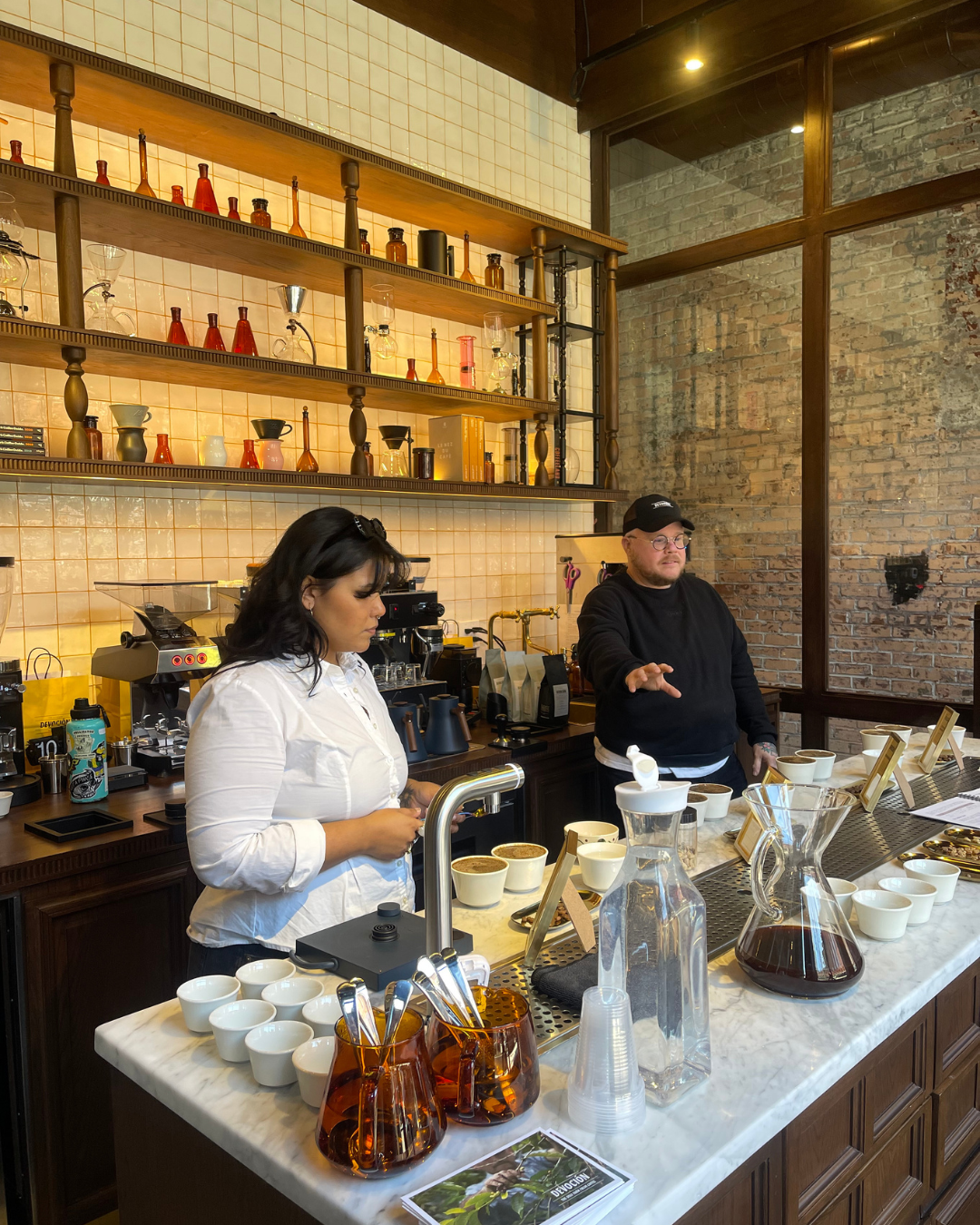
The laboratory is the first room. It sits at the front of the 148 Grand Street space, separated from the main café by glass visible from the street, which is the point. Dark wood apothecary shelving behind the marble counter holds amber bottles, Chemex brewers, pour-over drippers, and glass laboratory equipment that would not look out of place in a perfumery. Multiple editions of the New York Coffee Guide are stacked on the upper shelf, a credential quietly displayed.
The La Marzocco espresso machine behind the bar signals professional seriousness to anyone who knows what they are looking at. The smell of coffee meets you at the door, not a roastery’s raw intensity but something more precise, more like a specific cup than a general category. This is where the tasting happens, and for the duration of the session, it holds your full attention.
The Café
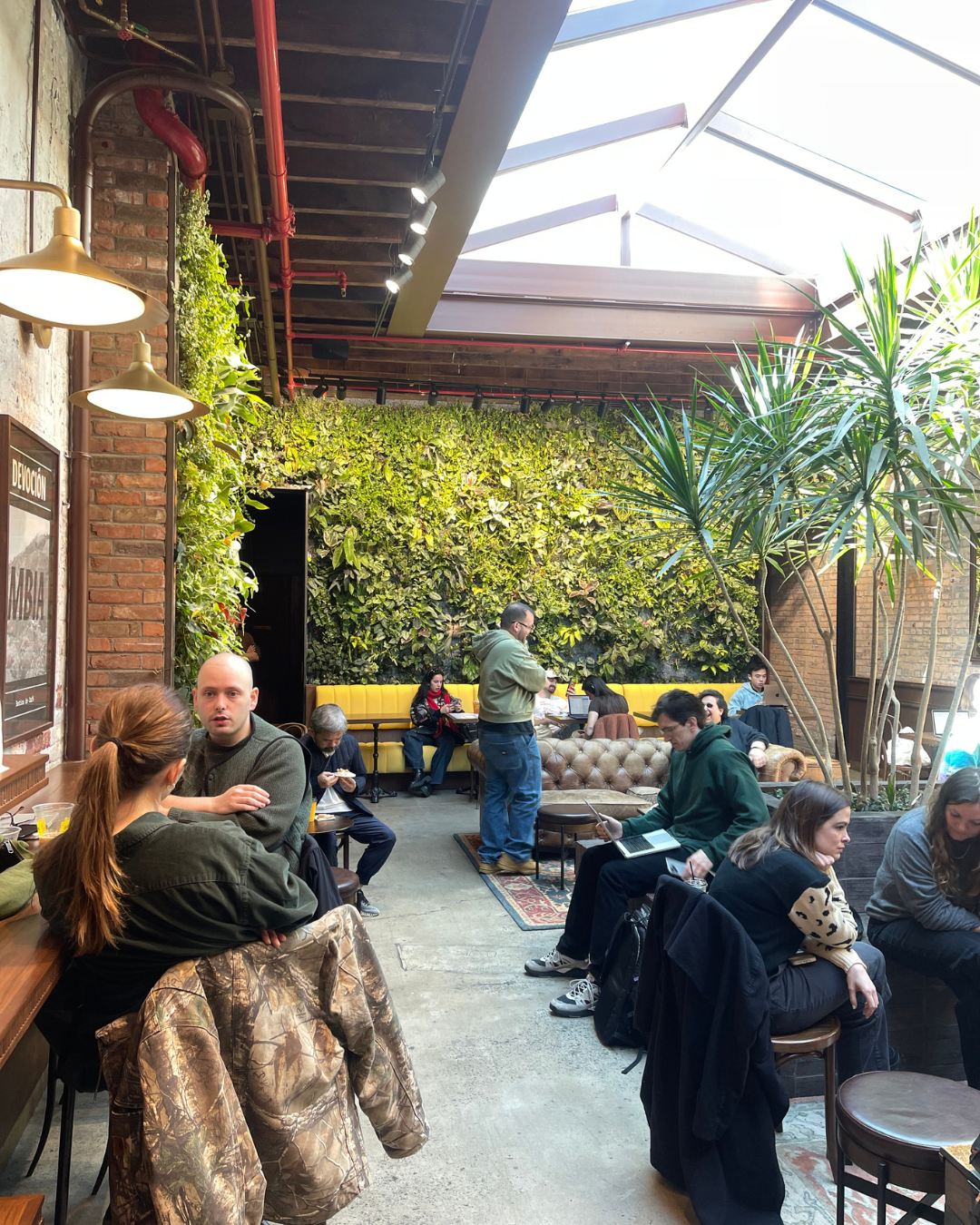
Step through the glass sliding door of the laboratory, and the space opens. To the right is the main café. A pitched skylight running the length of the roofline, a floor-to-ceiling living plant wall that is genuinely lush, with more than 35 species of Colombian plants maintained by the light that falls through the glass above. Leather Chesterfield sofas, Persian rugs on concrete floors, 19th-century warehouse brick, and exposed red pipes against the warmth of the greenery.
The contrast between the room’s industrial bones and the courtyard quality of the room is deliberate and effective. I came to it after the tasting, which meant I came to it already changed by what I had just tasted, and the room felt like the right place for that to land.

Devoción: The Freshness Principle
Devoción was founded in 2006 on a single operational premise: that the industry’s accepted timeline for getting coffee from farm to consumer was not a logistical necessity but a choice, and a bad one. Most specialty coffee in the United States is roasted from beans that have sat in warehouses for six to 12 months. The volatile oils that give a bean its individual character—its terroir, its acidity, its floral or fruit notes fade during that time. What remains is serviceable but not alive.
Devoción’s Model
Devoción sources directly from over 1,000 independent farms across Colombia, dry-mills the beans at its own facility in Bogotá, and ships them to Brooklyn without intermediaries or warehouse storage. What customers are served in the café has been roasted from beans that left their Colombian farm within the previous ten days, a claim that sounds like marketing until you understand that the industry standard is six to 12 months.
The bags I brought home make the difference tangible. By the time most specialty coffee reaches a roaster, these beans were already in my kitchen.
BKLS NOTE
Devoción often describes its coffee as arriving within about ten days of leaving the farm. That figure refers to beans moving through their direct sourcing system from Colombia to the Brooklyn roastery. What matters in the cup is simple. The coffee being served is dramatically fresher than beans that have spent months in warehouse storage, and the difference in the cup is immediate.
The Ritual
The Coffee Tasting session at the Laboratorio runs about an hour and is intentionally small; a handful of participants gathered around the marble counter.
The session is led by James McCarthy, Devoción’s education director and the 2013 World Brewers Cup Champion, working alongside another educator, Danielle [Dani], who manages brewing and guides cupping. McCarthy explains the process with the ease of someone who has spent years thinking about coffee at a technical level. Danielle moves between the bowls with practiced efficiency, preparing each stage of the tasting as the discussion unfolds.
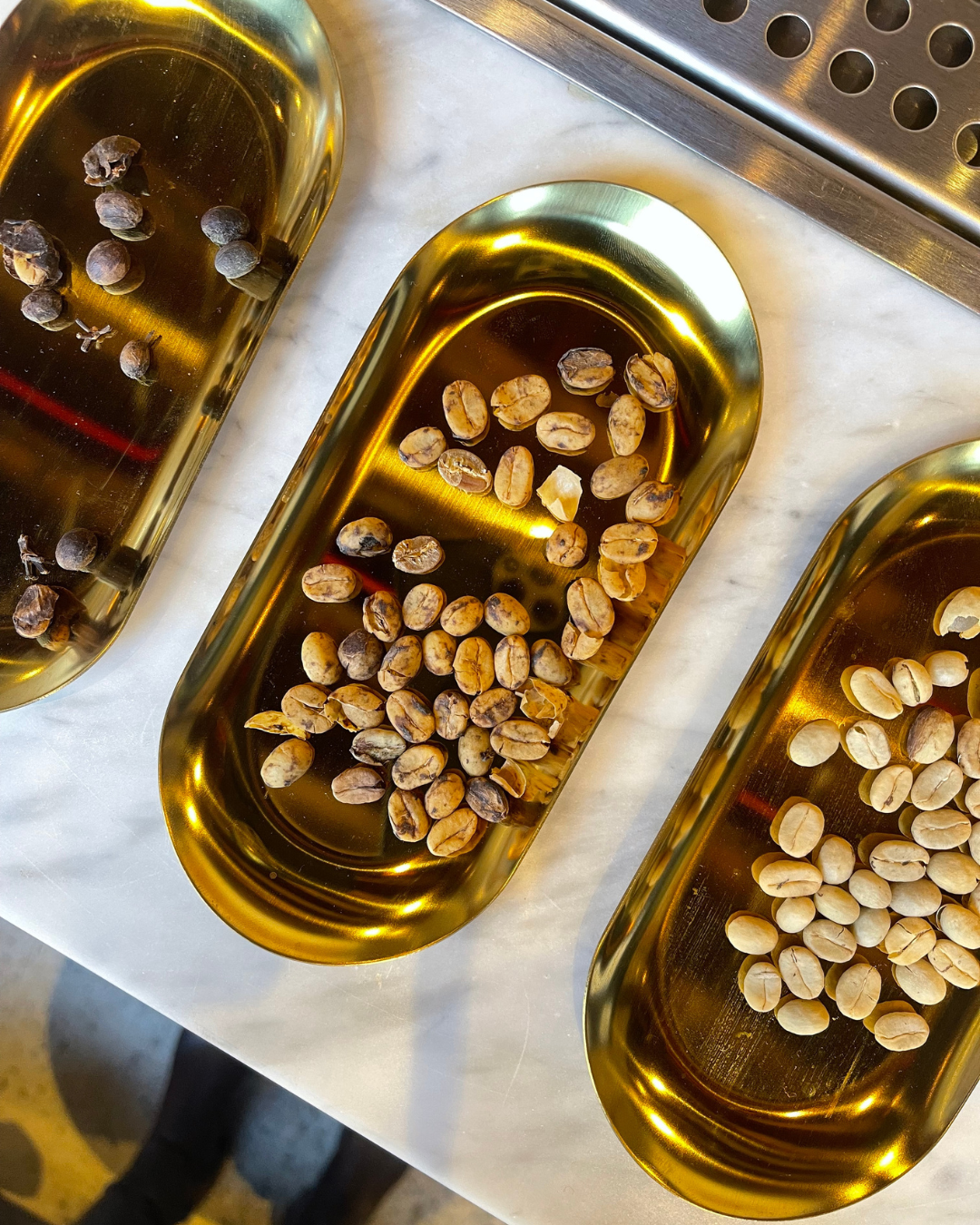
Before the coffee, the green beans. Three gold trays sit on the marble counter, showing the coffee cherry at three stages of its journey. On the far left, the dried cherry, the outer fruit still intact, wrinkled and dark. In the center, parchment-stage beans, pale tan and irregular, just milled. On the right, fully processed green beans, clean and cream-colored, the form in which they travel from Bogotá.
Most coffee drinkers never see this progression from cherry to green bean. Once you do, the drink in your cup reads differently. It is an agricultural product moving through several stages of transformation long before it meets heat.
The Cupping Process
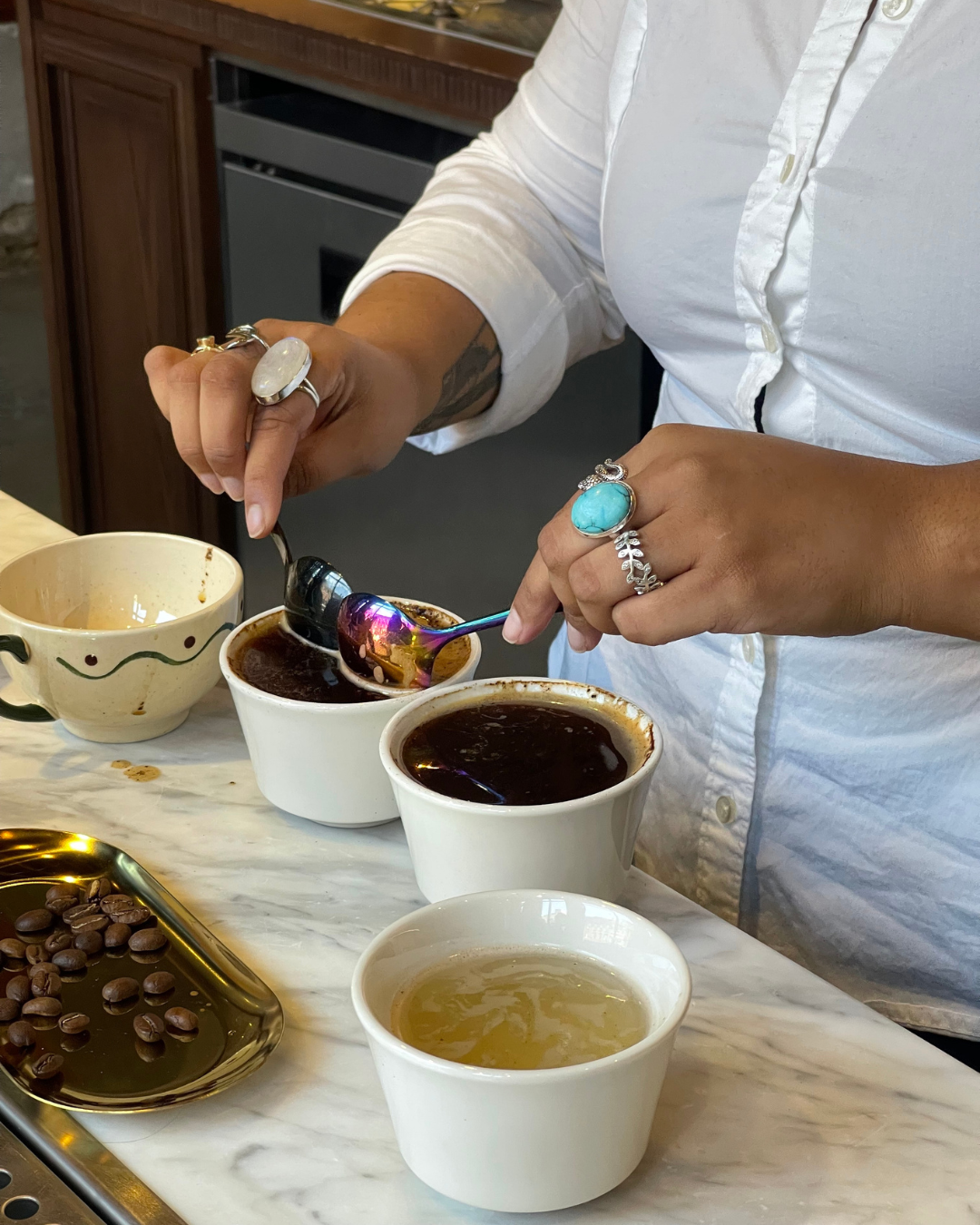
The cupping ritual follows Specialty Coffee Association standards. Four coffees were presented simultaneously in white ceramic bowls. The grounds already set, the cups waiting. The first step is fragrance: nose directly to the dry grounds, inhaling the coffee before water changes it. At this stage, the fragrance is immediate and unmistakable.
Then the water, just off the boil, poured directly over the grounds. Four minutes of steeping forms the crust: a compressed layer of grounds floating on the surface of the coffee, sealing the aromatic compounds beneath it.
Breaking the crust is the theatrical moment of the session. A spoon pushed through the surface releases a concentrated burst of steam and aroma. The purest expression of what is in the cup, the moment before oxygen begins to change it. This is the point where Devoción’s freshness claim becomes a physical experience rather than a marketing statement.
The aroma that rises when the crust breaks on fresh Colombian coffee is different from what rises from a months-old cup. It is louder, more specific, more insistent.
Then the slurp. The cupping spoon is dipped, coffee is drawn in fast, loud, and forcefully, aerating it across every taste receptor simultaneously. This is not bad manners in a cupping room; it is the correct technique. The slurp spreads the coffee across the palate in a way that slow sipping cannot replicate, which is why the professional Q-Graders who assess coffee quality work this way, and why it is the part of the session that surprises every first-time participant.
Open Lab
After the formal cupping ends, the session opens into what Devoción calls the Open Lab, time for questions, second tastings, and a chance to revisit the bowls with the educators. It turns the demonstration into a conversation, which is where most people finally understand what they just experienced.
The surprise is useful. It breaks the assumptions you brought in with you and makes you pay attention in a different way.
The Two Coffees
Of the four coffees tasted that Wednesday, the two I brought home show the full range of what the Devoción Laboratorio is doing.
La Divina — Women in Coffee
The first was La Divina, Women in Coffee. A washed Castillo grown at 1,900 metres by producer Juliana Guzmán, sourced as part of Devoción’s ongoing series dedicated to women-led farms in Colombia. The Castillo variety is a Colombian-developed hybrid known for clean, balanced profiles, and at altitude with a washed process. The fruit is removed before fermentation. The process keeps the cup clean and precise. What you taste is the terroir itself.
This was the coffee that stopped me mid-slurp. The floral note from the session belonged here. High and precise. Not what most people think coffee tastes like, until they taste it once and never forget it.
Striped Borbón — Wilton Benítez
The second was the limited edition Striped Borbón by Wilton Benítez. And it is the opposite argument. Wilton Benítez is a Colombian producer based in Cauca whose experimental approach to processing has made him one of the most closely watched names in the specialty coffee world.
The Striped Borbón is a rare genetic mutation of the Borbón variety, striped red and yellow on the branch, signalling a different sugar profile from standard Borbón. Benítez processes it through anaerobic extended fermentation: cherries sealed in oxygen-deprived tanks, fermentation intensifying the fruit compounds in ways that conventional processing cannot achieve.
The result is on the bag: Passion Fruit, Green Apple, Dried Currant, Rose. Where La Divina strips coffee to its origin, the Striped Borbón pushes processing to its limits. Two coffees from the same country, the same roaster, the same Wednesday morning. The contrast between them makes the argument on its own. Both extraordinary. Both are alive in ways months-old coffee is not.

The Upcoming Classes
The Laboratorio at 148 Grand Street runs an ongoing education series with four core offerings. All are led by Devoción Education Director James McCarthy, the 2013 World Brewers Cup Champion and a specialty coffee professional with more than twenty years of experience. Sessions are intentionally small, usually limited to four to eight participants.
The Coffee Tasting is the entry point. It is a one-hour guided cupping that introduces fragrance, aroma, body, and mouthfeel. This is the session described in this article. Cost: $10 plus Eventbrite fee.
The Latte Art class focuses on the science of milk texturing and the craft of pouring. The class is limited to four participants and includes a complimentary bag of Devoción coffee. Cost: $220 plus Eventbrite fee.
The Espresso Basics intensive runs three hours and is limited to four participants. It covers espresso preparation, extraction fundamentals, and espresso based drinks. It is the most advanced option for anyone serious about making espresso at home. Cost: $335 plus Eventbrite fee.
| Date | Class | Time |
|---|---|---|
| April 25 | Espresso Basics | 10 AM |
| April 25 | Latte Art | 2:30 PM |
| May 2 | Espresso Basics | 10 AM |
| May 2 | Latte Art | 2:30 PM |
| May 9 | Coffee Tasting—Free | 10 AM |
| May 16 | Espresso Basics | 10 AM |
| May 16 | Latte Art | 2:30 PM |
| May 23 | Espresso Basics | 10 AM |
| May 23 | Latte Art | 2:30 PM |
| May 30 | Espresso Basics | 10 AM |
| May 30 | Latte Art | 2:30 PM |
BKLS NOTE
Book through Eventbrite. The Coffee Tasting is the right entry point for a first visit. The Espresso Basics intensive is for the reader who has already decided that home espresso is worth taking seriously. Sessions fill—book early.
The Experience
The tasting ends quietly. The conversation slows, and the room settles back into its laboratory rhythm. It is the kind of experience that changes how you taste coffee long after you leave.
What to Know Before You Go
The Coffee Tasting session at the Laboratorio costs $10 plus an Eventbrite fee. No prior knowledge is required. The session introduces fragrance, aroma, the cupping process, and a guided tasting of several Colombian coffees. Groups are small, and questions are encouraged throughout.
After the tasting, we were offered pastries from the café kitchen. The standout was a guava and cheese croissant, vividly red and intensely flavorful. It is worth ordering again if you arrive early or stay after the session.
The café at 148 Grand Street is open Monday through Friday from 7 AM to 6 PM, and Saturday and Sunday from 7:30 AM to 6 PM.
BKLS NOTE
Skip the milk for your first cup. Devoción’s freshness shows most clearly in a black pour over. The mineral clarity and acidity read differently without dairy.If you are ordering at the bar instead of attending a tasting, ask what is currently in rotation from the microlot or limited edition shelf. The answer changes weekly. That is the whole point.